It started as a LinkedIn joke about coding eras, in a thread from Ethan Mollick.
We are leaving the Old Code Age, the Paleocodic, the bespoke era where if you needed a novel program you commissioned a codesmith to hand-craft one, character by character. Soon we will look back on that work with wonder. How could anyone have built this by hand, typing one character at a time?
The joke landed. But the replies underneath it were better than the joke, because together they were the entire argument about the future of knowledge work, compressed into a comment thread. So let me translate them.
One sharp reply objected that the joke skips a century. Code did not go straight from artisanal to automated. It passed through an industrial revolution first: software factories, offshore assembly lines, sprints, developers as interchangeable operators, code as a commodity measured in story points. That was coding’s Fordism.
The correction is exactly right, and it’s true of law too. Law industrialized decades ago. Document assembly. E-discovery factories. Contract lifecycle management. LPOs and ALSPs. And especially, the leverage pyramid. Associates as interchangeable operators, output measured in six-minute units, diligence and contract review turned into a commodity you could buy by the pound. That was our Fordism, and it worked. It scaled. It built the modern firm.
So we are not leaving the Paleojuris. We are leaving industrial law. What ends with it is the tradeoff that built it: scale bought with diluted judgment.
Where the coding argument goes soft is the prediction of what comes next. The claim is that once mass production becomes cheap, the world returns to intention and judgment and craft. Craft beer after the mega-brewery. Specialty coffee after instant. Vinyl after streaming. The artisan does not disappear. The artisan starts directing the workshop.
It is a lovely idea and it is wrong. Law is where you can prove it, because we have already run the experiment.
Look at what those examples actually have in common. Craft beer, vinyl, and specialty coffee are anti-scale luxuries. The refusal to scale is the product. You pay the premium precisely because it was not mass-produced. Now look at how those businesses actually end. Craft brewing and specialty coffee are churn machines: dreams funded by cashed-out 401(k)s, sold by the smart founders to the next dreamer before the math arrives. The last one holding the potato gets a prize: their name on the bankruptcy filing. That model already exists in the legal profession. It is the boutique and the solo practice. And it is not the future. It is a crowded present that fails on a schedule. Not because the work is bad. Often the work is superb. It fails because craft without leverage cannot carry a payroll, cannot answer the phone when the founder is on a plane, cannot cover a book of clients who need counsel on their timeline instead of the lawyer’s. Artisanal + no scale = a hard ceiling. Reliably. Across industries.
The retreat to craft is a failure mode we already know by heart. Prescribing it as the future is prescribing the exact thing that has always ended in limited growth at best, insolvency at worst. The boutiques that thrive are not a counterexample. They thrive by choosing the ceiling. That may be fulfilling, a good life, even a profitable one. It is not a scalable architecture. Even the winners do not get to keep it. The boutique that compounds real profits ends one of three predictable ways: absorbed into a bigger firm, dissolved in a messy practice divorce, or inertia wins and the founder retires and turns off the lights. Judgment that lives in a few heads has no succession plan.
Somewhere in every version of this conversation, someone points at the billable hour, and they are not wrong that it will age badly. Charging more the slower you work is a barbarism our grandchildren will find hard to believe.
But the metric is a distraction, and it is an easy one to swat away. Flat fees exist. Fixed-scope and project-based pricing exist. They have existed for years and they changed the pricing, not the pyramid. If the billable hour were the disease, we would already be cured. The constraint was never how the work is measured. It is the nature of the work itself.
Legal judgment has always been two things at once: episodic and rationed. Episodic, because you get counsel in discrete engagements: you have a problem, you call the lawyer, the lawyer thinks, you get an answer, the engagement closes. Rationed, because the answer is throttled by one person’s calendar. You get judgment when you can get the human who holds it.
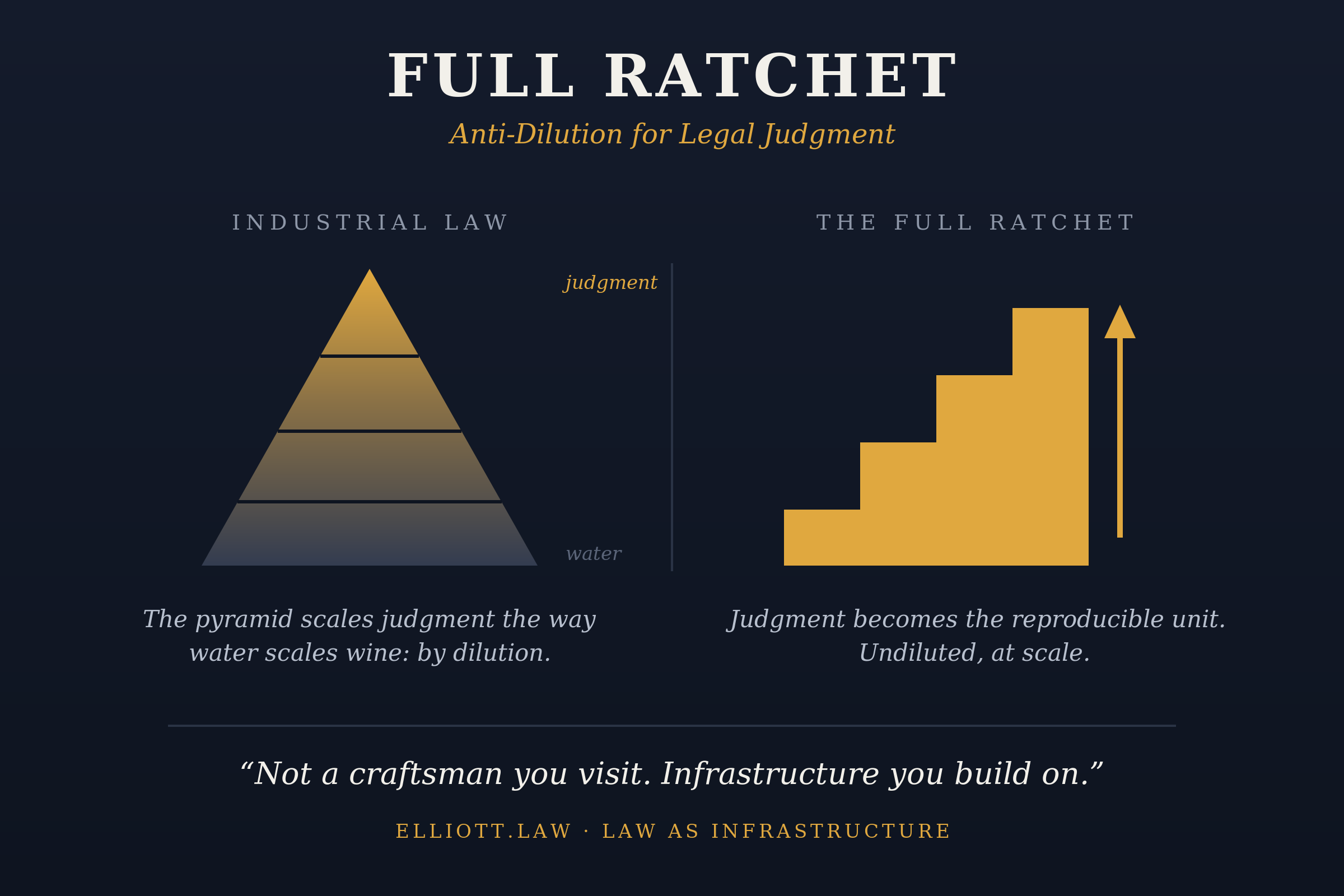
The pyramid was our only way to scale that. And the pyramid scales judgment the way water scales wine: by dilution. Every associate you add to buy throughput subtracts from the average judgment in the room. Quality and scale were not a setting you could fine-tune. They were a real, structural tradeoff. You could have deep judgment or you could have reach. Buying more of one cost you the other.
This is the trap underneath the whole profession, and it is why the artisanal path was never actually available to anyone who wanted to grow. It was not that lawyers lacked the taste for craft. It was that craft was economically capped at the size of one person’s attention.
The irony the industrial era never resolved is that to get scale, we made people behave like machines. We took judgment, the most human faculty we have, broke it into rote, routed the pieces to qualified junior humans, and ran it like a process. We industrialized law by asking humans to be robots, then billed for the hours the rote took. Call it the human-as-robot bargain: the only way to scale judgment was to strip the judgment out of it.
It is the mirror of a mistake I have named before. The Humanoid Robot Fallacy is the error of judging a new system by how well it mimics the human tasks it was built to eliminate: the robot in the driver’s seat working the pedals, when the real move is a car that needs no driver. The two errors run in opposite directions from the same root. The old bargain made humans imitate machines to get scale. The fallacy makes machines imitate humans to sell it. Neither redesigns the work. And both are about to be overtaken by the shift that finally does.
Another voice in the coding thread asked a question that applies equally to law: was the codesmith’s value ever the code, or was it the judgment about what to build and what to refuse to build? In law the question answers itself. The value was never the document. It was the decision about what to sign and what to walk away from. The artifact was only ever the residue of the judgment. We just could not sell the judgment directly, so we sold the residue by the hour.
So what is new is not craft coming back. Craft never left. What is new is a mechanism for making senior judgment executable, reusable, and available without pyramid leverage and without calendar constraints. Today’s systems approximate this unevenly. The direction is not in doubt.
This is not the artisan getting promoted to foreman, directing a workshop of machines. That version is still capped by one person’s attention; you have simply moved the bottleneck up a floor. (I wrote about that model in The Full Stack AI Law Firm.) The real shift is stranger and larger. The judgment itself becomes the reproducible unit. The taste, the risk instinct, the sense of which term is fatal and which is complexity theater (the thing that used to live in one head and get rationed by one schedule) becomes something you can run at scale without diluting it.
That is the inversion of the whole industrial bargain. The old deal made humans act like machines to get reach. The new one lets machines carry the rote so that human judgment can finally be the reach. Artisanal judgment, unconstrained, at scale, for the first time in the history of the work. The pyramid diluted judgment to buy reach. This is the first anti-dilution clause the work has ever had: full ratchet, the kind that protects early holders through every later round, guarding the thing the pyramid always watered down.
Another reply said the shipped product of the future is intent, not the hand-carved artifact. That line translates cleanly to law. We stop delivering the carved contract and start delivering the standing risk posture that regenerates it. Law stops being a thing you schedule and becomes ambient.
The boutique is episodic by definition. You visit the craftsman; you leave with an object; the shop closes behind you. What is coming is not a better or faster boutique. It is judgment that does not close behind you, embedded in the operation it serves, available at the speed of the business rather than the speed of the calendar.
That is what we are leaving behind. Not the Paleojuris. Not a craftsman you visit. Infrastructure you build on.