
There's a new AI law firm every week. Most of them are one of two things: a traditional firm that added an AI subscription to the tech stack, or a solo lawyer-coder who built agents to replicate themselves at scale.
Neither of these is the model.
The first is optimization. The second is cloning. Both assume the underlying structure of legal services stays essentially the same — client calls, lawyer responds, matter opens, bill goes out. They're just trying to do that loop faster or cheaper.
The full-stack AI law firm is a different architecture entirely. It's not faster. It's not cheaper. It's structurally different — legible to AI agents, transactable by AI agents, and designed so that human legal judgment enters the workflow exactly where it's irreplaceable and nowhere else.
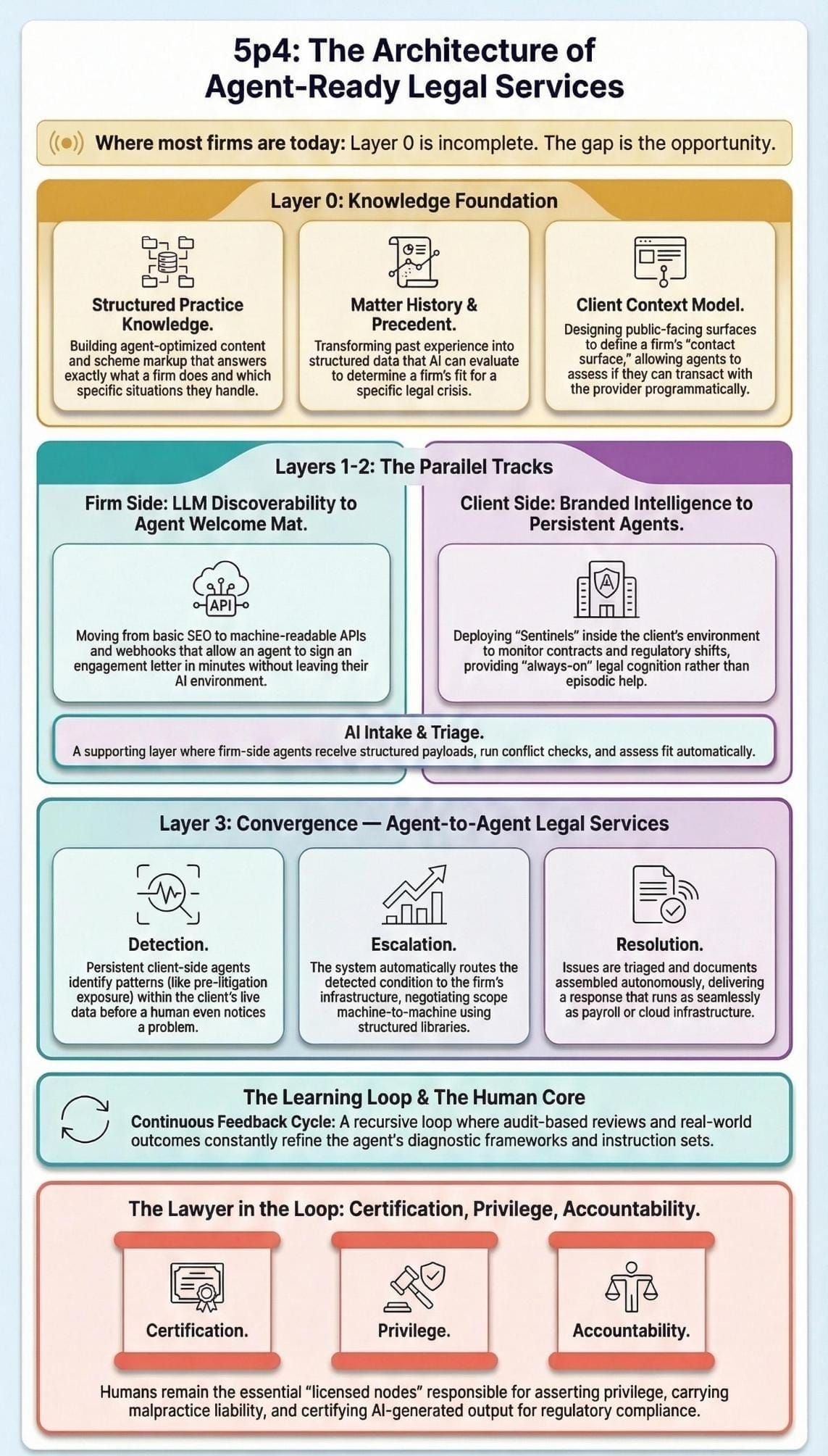
There are four layers. Two on the firm side. Two on the client side. A convergence point where they meet. And a legal layer underneath that makes the whole thing operative.
Here's what it looks like.
The firm side: from discoverable to transactable
The first move is LLM discoverability. Most law firms exist as websites — text, bios, practice areas, the usual cemetery of keywords. An AI agent looking for outside counsel reads that like a human reads a phone book. Not legible. Not structured. Not useful.
LLM discoverability means your firm publishes machine-readable metadata about what you actually do. Not "we handle complex transactions" — that's useless to an agent. Something like: cross-border acquisitions under $50M, target company in Latin America, U.S. acquirer, regulatory clearance in two jurisdictions. Now an agent knows how to route.
The second firm-side layer is the Agent Welcome Mat. This is the structured endpoint that makes your firm transactable — not just findable. It's the schema that says: here is how you engage us, here is what information we need, here is what we return, here is how we escalate when human judgment is required.
The Welcome Mat payload tells a client-side agent: we speak your language, we can be called, we know how to respond.
The client side: from requesting to deploying
The client side has two layers that mirror the firm side.
The Branded Intelligence Plugin is the GC-side equivalent of LLM discoverability. It's the encoded judgment layer the client deploys — their legal policies, their risk tolerances, their standard positions, their escalation thresholds. Not a chatbot. Not a FAQ. Not a folder with playbooks. A decision architecture that knows what the company has already decided so it doesn't keep asking.
The Persistent Client-Side Agent is what executes. It monitors contracts for expiration triggers. It tracks regulatory filing deadlines. It flags compliance gaps before they become problems. It runs continuously, not on demand. It doesn't call outside counsel when something breaks — it calls outside counsel when something is about to break, or when it encounters a question outside its decision authority. Structured escalation with defined handoff because the agent knows its limits.
The client side can be built internally — a GC with the right resources deploys their own. Or the full-stack law firm builds it for them. Either way, the architecture is the same.
The convergence: transaction, not relationship
When the client-side agent escalates to the firm's Agent Welcome Mat, what happens is a transaction, not a conversation. Not a relationship. Not a lunch meeting.
The agent presents a structured problem. The firm's infrastructure receives it, classifies it, routes it. A lawyer is engaged when the matter requires judgment that can't be encoded — when the stakes require certification, when privilege needs to attach, when someone needs to be accountable for the outcome.
The phone doesn't ring because no one is calling. The matter arrives as data. The engagement is structured. The output is certified.
The irreducible layer: why lawyers survive this
There are some things that AI cannot do: it cannot certify. It cannot hold privilege. It cannot be professionally accountable for legal advice.
Those aren't gaps in capability. They're structural features of the legal system. Certification requires a licensed professional. Privilege requires an attorney-client relationship. Accountability requires someone whose license and reputation are on the line.
The lawyer in the loop isn't a compromise because of AI's technical limitations. It's the layer that makes the whole architecture legally operative. The agent can research, draft, flag, route, and execute within defined parameters. But when the matter requires a legal opinion — when a client needs to rely on it, when a court might examine it, when a regulator might challenge it — a lawyer has to be in the chain.
Let's be clear about what this layer is and isn't. It is not the human judgment domain. AI judgment is faster, more consistent, and increasingly more reliable than human judgment across most of the legal tasks that consume attorney time. That's not a threat. It's a feature of the architecture.
This is the human consequence domain. Until institutions and regulatory bodies have an apocalyptic change, someone has to hold a law license. Someone has to carry malpractice insurance. Someone has to be professionally accountable when the advice is wrong and a client is harmed. AI can reason through a legal problem with more precision than most lawyers. But it cannot be disbarred. It cannot be sued for malpractice. It cannot stand in front of a bar disciplinary committee and answer for the outcome.
What this means for firms building now
The firms that survive this transition aren't the ones optimizing throughput. They're the ones becoming infrastructure underneath client autonomy.
Instead of: "Clients call us. We solve problems. We send bills."
Now: "Clients deploy our agents. Our agents solve problems. When they can't, they escalate to us. We certify. We hold privilege. We account."
The phone doesn't ring because there's no one on the other end to hold it.
But the infrastructure underneath that autonomy? That's built by lawyers who understood the architecture first.