
Every week, I watch CEOs make the same mistake: traditional legal is slowing them down, so they hire fractional legal to “fix it.”
That’s when I know they’ve misunderstood the problem entirely.
In Article 8, we established the law of compounding velocity: every decision resolved sooner increases the slope of operational throughput. Delay compounds disadvantage. Speed compounds advantage. But the velocity law principle doesn’t just favor speed, it creates temporal incompatibility with fractional availability.
Not because fractional lawyers lack expertise (many are brilliant), but because fractional engagement models operate on lawyer schedules while velocity law operates on market physics.
Last month, a fractional CFO’s email signature showed me exactly why these models cannot coexist.
The Email Footer That Killed a Deal
We were managing a corporate readiness engagement for a client preparing to raise capital. These projects live or die on execution speed. Timing determines valuation multiples, and delays destroy deal momentum. We needed current financial statements, clean cap table documentation, and compliance certifications.
Every email to their CFO produced identical delays. The reason was obvious.
His email signature announced: “Please note: I am fractional and dedicate approximately one day per week to this engagement, hence the delayed response times.”
One day per week. For a company attempting to close a funding round within compressed market windows.
The outcome was inevitable: we couldn’t access critical information when investor timelines demanded it. The project stalled. The capital raise timeline extended. Everyone appeared incompetent—the fractional CFO, company leadership, and our advisory team.
But the deeper issue wasn’t CFO performance. This was systems failure. Properly designed financial infrastructure would have rendered CFO availability irrelevant. Data would have been accessible instantly. Documentation would have remained current and organized. Compliance materials would have been investor-ready continuously.
Instead, they had purchased 20% of CFO bandwidth and received 20% of CFO capability—precisely when they required 150% performance.
When Article 8’s Steve signed that licensing agreement without legal review, he wasn’t being reckless. He was operating under velocity law: the 48-hour opportunity window made perfect terms next week worth less than adequate terms today.
Fractional models assume legal decisions can be scheduled, queued, and batch-processed during available hours. But business reality creates random, urgent decision requirements that don’t respect professional calendars.
The incompatibility is absolute: business velocity depends on decision speed, but fractional availability depends on lawyer schedules. When competitive advantage requires immediate decisions, scheduled availability creates systematic disadvantage.
A brilliant lawyer available Tuesday cannot help you with Thursday’s crisis. A comprehensive legal analysis delivered next week cannot capture Friday’s opportunity window.
The failure isn’t about capability. It’s about availability.
When Fractional Actually Works (And Why It’s Still Wrong for Legal)
To be transparent, fractional models succeed brilliantly in specific contexts. A fractional CMO delivers excellent value when marketing strategy can be scheduled weekly. A fractional CFO works effectively in stable slow growth environments when financial operations are predictable and reporting is periodic.
These succeed because the work has schedulable execution, batch processing capability, and non-urgent timelines.
But legal work for growth companies operates on precisely opposite characteristics: unschedulable demands that explode during product launches, real-time requirements that emerge from customer negotiations, and urgent deadlines that operate on external timelines, deals on competitor timelines, crises on crisis schedules.
The Thursday Night Reality Check
Legal emergencies follow this pattern constantly. Consider 11:47 p.m. Thursday. Your lead engineer messages your head of product in Slack—they’ve discovered a critical problem. The API integration your largest customer has been awaiting, the integration that closes your Q4 numbers, requires processing of personal data not disclosed in current privacy policies and not addressed in data handling agreements.
Your customer’s legal team reviews the integration Monday morning. If privacy documentation doesn’t match technical implementation, they’ll ice the deal and defer decisions to Q1. Your competitor will capture the market window you’ve pursued for six months.
What does your “fractional GC” accomplish in this scenario?
Nothing. Because they’re offline. Because their engagement excludes weekend emergencies. Because fractional legal operates on lawyer schedules, not business reality. Because their email signature promises response delays until next Tuesday.
Meanwhile, embedded legal infrastructure identifies privacy gaps automatically, generates compliant policy language from pre-approved templates, and routes updates through established approval workflows. By Friday morning, your customer’s legal team receives complete documentation matching your technical capabilities.
The difference isn’t lawyer competence. It’s system architecture.
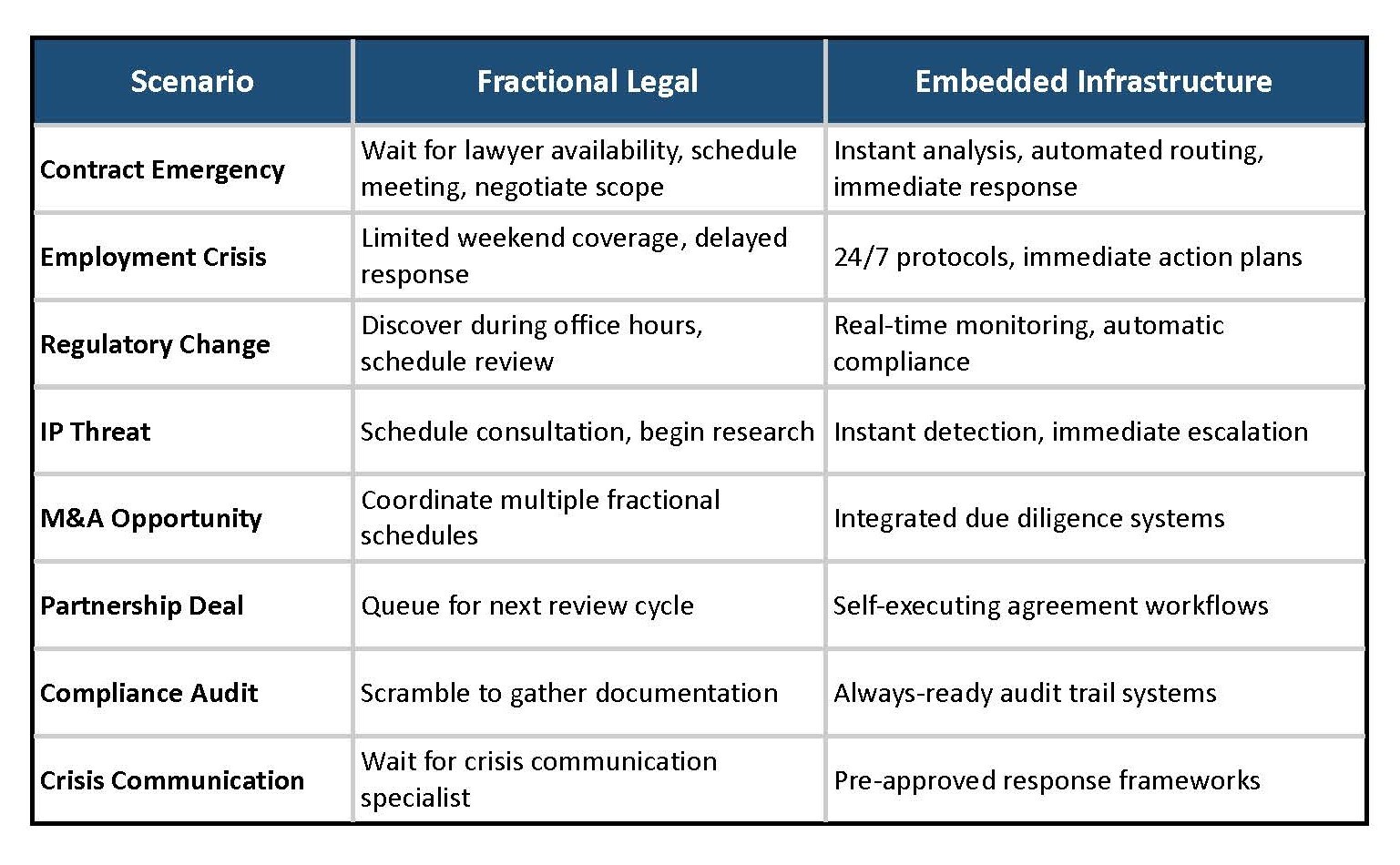
But embedded GC-as-a-Service doesn’t just mean automated systems. It also means operationally committed humans who don’t think fractionally.
The Sunday Afternoon Brand Threat: When Embedded Actually Means Embedded
A recent Sunday at 1 p.m., I was conducting brand monitoring for one of our celebrity-led major apparel brand clients, preparing for a strategy meeting the following week. I discovered a publisher using the celebrity-founder’s name and likeness to promote unsavory products, the type of association that could destroy years of carefully built brand equity.
I wasn’t doing this because it was “my scheduled day.” I was doing it because embedded infrastructure means proactive protection, not reactive consulting.
I immediately emailed the CFO with the discovery and threat assessment. His response arrived within minutes. On Sunday afternoon.
The CFO immediately notified the CEO, internal legal team, and board members. They scheduled an internal triage meeting for 9 a.m. Monday morning with clear mandate: “support and expedite in any way possible.” A call with our team appeared on my calendar for Monday at 4 p.m. with subject line “report the resolution.”
The message was unmistakable: “We are all guns.”
By Tuesday morning, cease and desist letters were delivered, takedown notices were filed, and brand protection protocols were activated across all monitoring channels. What could have been a weeks-long brand crisis damaging celebrity reputation and company valuation was contained within 48 hours.
Following this crisis, we expanded the use of automated brand monitoring systems to catch these issues systematically (the requisition wrote itself). But the crisis was resolved because embedded infrastructure was already operating—human infrastructure that works like company operators, not like fractional consultants.
This is embedded GC-as-a-Service in action:
- Proactive protection means work happens even when it’s not “scheduled”
- Immediate escalation because embedded teams operate with owner mentality
- Systematic mobilization because everyone understands “we are all guns”
- Infrastructure investment because embedded teams build systems that prevent future crises
Compare this to fractional legal response: No Sunday research (not a scheduled day). Threat discovered during next review (if at all). Monday morning email: “We should discuss this.” Tuesday meeting scheduled. Wednesday call with outside counsel. Thursday research begins. By the time cease and desist letters are ready, the brand damage is done.
Why Availability Isn’t the Only Problem
But temporal incompatibility isn’t the only reason fractional models fail. There’s a deeper issue: misaligned incentives and incomplete business context.
When Steve signed that licensing agreement in Article 8, a fractional GC would have provided expert analysis of IP restrictions, minimum order commitments, and co-marketing obligations. That analysis would have been technically correct.
But it would have been strategically incomplete because the fractional GC wouldn’t have known:
- Which competitor was courting the same partner
- Why the 48-hour window existed
- How this deal fit into quarterly revenue targets
- What distribution relationships were already strained
- Whether we could execute on minimum commitments given current production capacity
Expertise without alignment produces technically correct recommendations that are strategically wrong.
This is why Article 10 will explore the in-house advantage: it’s not that in-house lawyers are more skilled than fractional experts. It’s that alignment with business objectives—understanding the strategy, knowing the constraints, having skin in the game—matters more than pure legal expertise when velocity law governs your market.
A fractional expert optimizes for legal perfection. An aligned operator optimizes for business velocity within acceptable risk parameters.
The second approach wins every time.
The Strategic Imperative
Stop asking: “Who can we hire for 10 hours per week?”
Start asking: “What competitive advantages are we missing while we wait for lawyer availability?”
Business velocity creates temporal incompatibility with fractional models. The mathematics are absolute: when decision speed determines competitive advantage, scheduled availability creates compounding disadvantage.
But recognizing that fractional models can’t satisfy velocity requirements raises harder questions:
- If you can’t afford full-time general counsel, what architecture actually works? (The embedded infrastructure we’ve been building throughout this series)
- Why do some in-house lawyers enable velocity while others create bottlenecks? (Article 10: The alignment advantage that trumps pure expertise)
- How do you build legal teams that accelerate business velocity instead of constraining it? (Article 11: The operator vs. consultant identity choice, and Article 12: How to structure legal teams for speed)
- What are these delays actually costing you in lost opportunities and competitive positioning? (Article 13: The quantifiable business impact of legal velocity)
The companies that understand law as infrastructure and embedded GC aren’t just moving faster than competitors still stuck in fractional thinking, they’re closing deals while competitors queue for legal review.
Next in Series:
Article 10: The In-House Advantage — We show how alignment with business objectives matters more than pure legal expertise and explore why In-House Experience Changes Everything.
This is Article 9 of The Law as Infrastructure series documenting the transformation from traditional legal services to embedded legal capability.