For a century, companies have rented law.
They called when something broke, paid by the hour to slow the damage, and mistook reaction for control.
The system still functions, but it’s no longer competitive.
The chaos from the Tuesday Morning Gauntlet—the product launch colliding with IP gaps, privacy violations, and compliance landmines—only exists when judgment sits outside your system. When legal intelligence is embedded, those collisions don’t form because the infrastructure prevents them.
The next generation of companies isn’t outsourcing judgment. They’re embedding it. Legal intelligence now runs inside their operations, informing every decision at business velocity.
This shift isn’t theoretical; it’s structural. Finance, HR, sales, every other function, has already transitioned from manual expertise to embedded systems. Legal is simply the final holdout.
What follows is the operating manual for the model already in use by the most adaptive organizations.
This is how law becomes infrastructure.
The Shift—From Legal Function to Legal System
Corporate legal operations evolved in three predictable stages:
- External advice: purchased as needed, expensive and slow.
- In-house counsel: faster, closer to context, but capacity-limited.
- Embedded intelligence: continuous, system-driven, and scalable.
In this third stage, legal doesn’t respond; it anticipates.
When a contract is created, standard terms are pre-applied and deviations automatically flagged. When product development touches data, the compliance framework adjusts itself. When employment actions trigger risk, the decision tree generates required steps before exposure occurs.
This isn’t cheaper lawyering; it’s law fused into operations. The difference isn’t cost structure. It’s architecture.
The most adaptive companies are already executing this model while the rest are still evaluating it.
The Architecture:
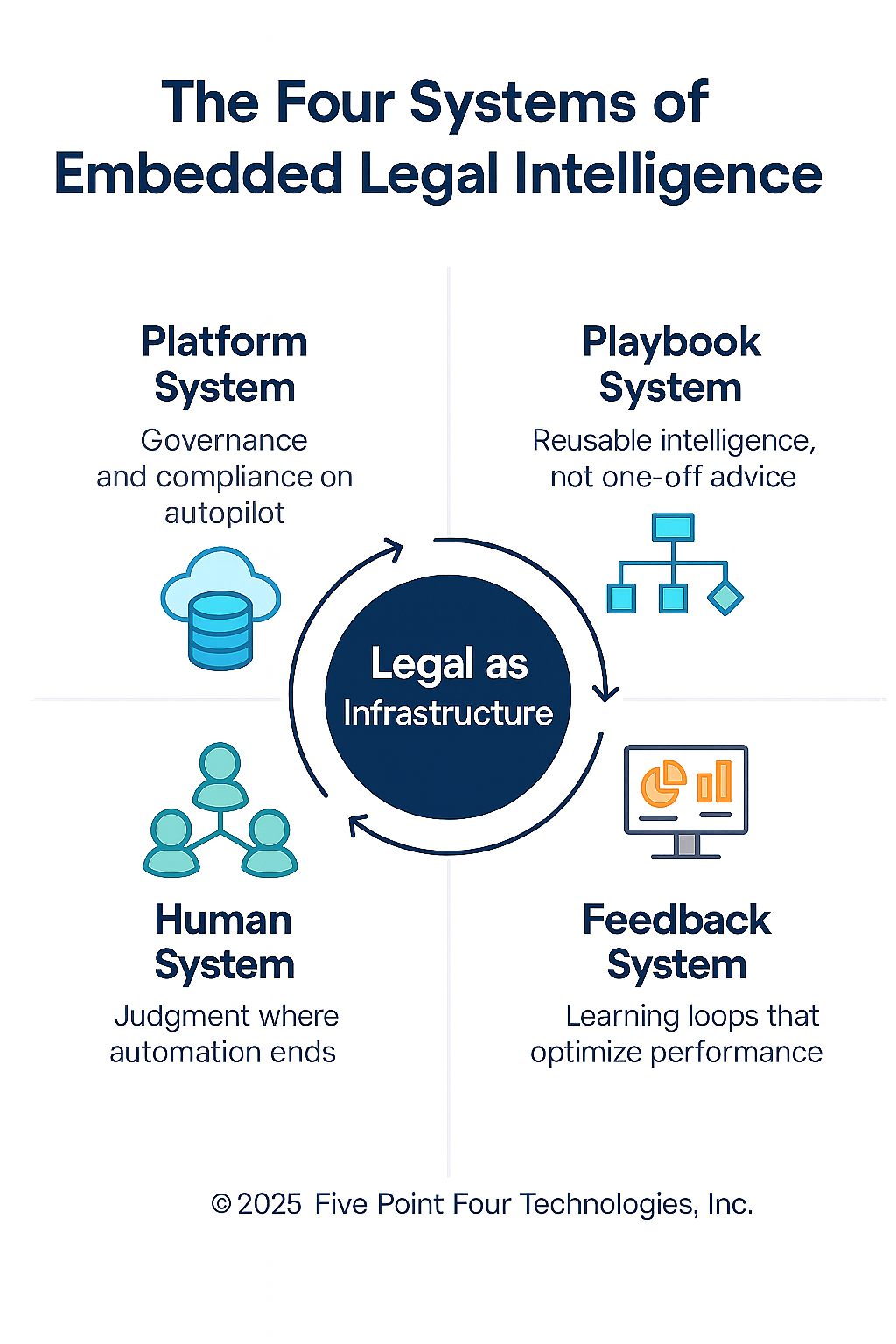
1. Platform System—Digital Backbone
Corporate entity data, contracts, and governance records live in connected systems. Obligations, renewals, and certifications are tracked automatically. Governance dashboards surface exceptions before deadlines exist.
Legal housekeeping becomes background process, not quarterly emergency.
2. Playbook System—Codified Judgment
Playbooks evolve from static PDFs to dynamic logic frameworks. “Decision Matrix,” “Judgment Router,” “Crisis Audit,” and “Governance Composer” tools route decisions through approved paths, escalate edge cases, and preserve outcomes for learning.
Every resolved issue becomes reusable intelligence.
3. Human System—Embedded Operating Teams
A general counsel operates inside company channels—Slack, Teams, email—not as an external advisor but as a functional node in daily communication. Specialized pods for employment, commercial, IP, and compliance are engaged through structured workflows.
Human judgment is deployed where automation ends, not where it begins.
4. Feedback System—Continuous Analytics
Automated tracking of time-to-decision for different legal request types reveals where bottlenecks persist and where systems work efficiently. Issue recurrence analysis identifies patterns requiring template updates or process redesign rather than repeated manual intervention. Risk velocity metrics quantify how quickly potential problems get identified and resolved before they become actual crises.
These data loops replace anecdotal reporting with measurable performance. The system learns continuously, identifying template failures, training gaps, and optimization opportunities. When these layers connect, legal stops being a cost center and becomes system uptime.
What follows is deployment: the blueprint that converts architecture into operating reality.
The Experience—Inside a GCaaS Environment
Inside a mature GCaaS environment, legal work stabilizes into flow state. Every contract request, policy update, or compliance trigger follows a defined path. Questions resolve at the right layer—automated where possible, escalated where necessary. Outcomes become system memory that accelerates the next decision.
Governance materials assemble continuously. Board readiness is constant. Budgeting shifts from variable cost to predictable infrastructure expense.
Legal doesn’t disappear; it integrates. It operates quietly, like power or bandwidth—always available, always measured. The experience isn’t the absence of risk; it’s the presence of durable order.
Economics—The Rational Inevitability
GCaaS replaces volatility with predictability. The cost of uptime is fixed while the cost of delay is exponential.
The model eliminates decision latency at the legal layer. Every day gained in contract turnaround, market entry, or compliance clearance compounds into financial advantage. Velocity compounds, and competitors still governed by hourly cycles can’t match it.
Traditional law firms profit from friction; GCaaS eliminates it. Infrastructure always wins over service.
This creates what we’ll explore in the next article as The Velocity Premium: the economic law that rewards companies operating at business speed with compounding advantages over those constrained by traditional legal timelines.
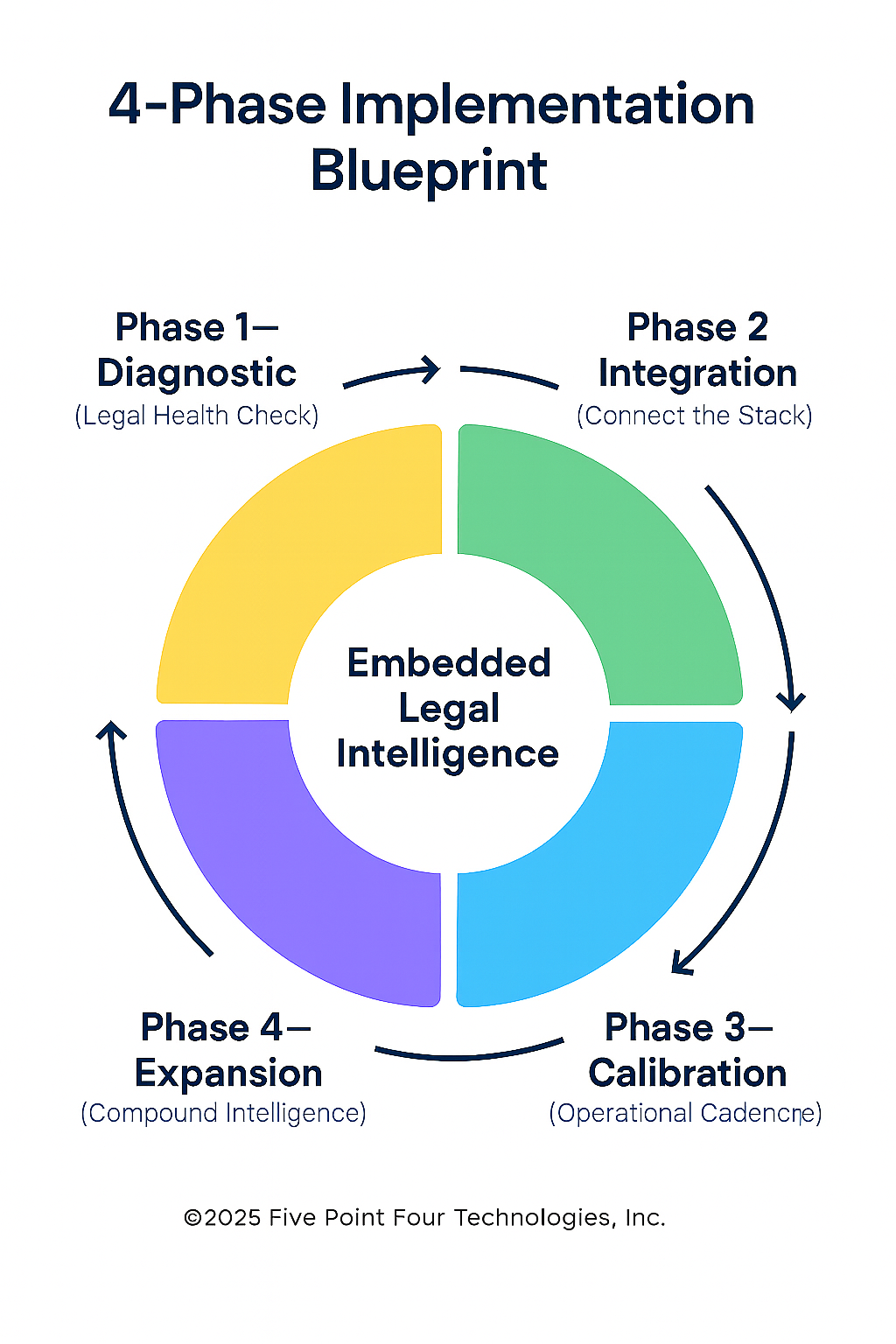
Phase 1—Diagnostic (Legal Health Check)
The assessment phase exposes where legal work slows business velocity. Every recurring request, decision point, and review cycle is mapped to reveal how judgment actually flows through the company. The analysis focuses on three dimensions: Frequency: how often the issue arises and how much time it consumes; Complexity: the number of inputs, approvals, or dependencies required for resolution; Impact: the cost of delay on revenue, compliance, or customer trust.
Each process is then classified as: (a) Automatable — rule-based work suitable for playbooks and templates; (b) Judgment-based — issues requiring real-time counsel embedded within operating teams; or (c) Specialized — matters demanding external expertise or bespoke intervention.
Output: a transformation roadmap with priorities, owners, and ROI estimates creating a visual model of where legal energy leaks, where automation creates lift, and where human judgment adds the most value.
Duration: ~2 weeks.
Phase 2—Integration (Connect the Stack)
Legal intelligence including contract generation, compliance checks, decision trees and escalation protocols are embedded into the business systems where business decisions already live. Salesforce generates and routes contracts automatically from approved templates, tracking deviations in real time. HRIS platforms trigger employment decision trees the moment a personnel action is initiated, producing documentation and escalation steps before exposure forms. Product management systems monitor data collection events against compliance frameworks, flagging gaps and updating policies on the fly. Every trigger point that once required a lawyer’s email now runs on a defined logic path. Judgment lives where business decisions already happen.
Outcome: reduction in legal cycle time within 30 days.
Phase 3—Calibration (Operational Cadence)
Velocity without governance becomes chaos. This phase establishes the operating cadence that keeps judgment aligned with business movement.
- Weekly tactical reviews surface live data from the Feedback System to identify friction and recalibrate workflows in real time looking at open requests, resolution times and risk velocity metrics.
- Monthly analytics sessions convert those signals into structural improvements: updating templates, refining escalation logic, and reallocating human support where automation stalls.
- Quarterly strategic sessions ensures that the system evolves with the company by synchronizing legal intelligence with business roadmap changes to adapt to new markets, products, or regulations.
By day 90, legal stops being a separate function and operates as integrated capacity, predictable, measurable, and embedded in planning cycles.
Phase 4—Expansion (Compound Intelligence)
Once embedded systems stabilize, intelligence compounds. Each iteration refines templates, automates additional workflows, deepens analytics and adds modules for new markets, products, and regulatory regimes. The organization evolves continuously rather than through episodic reinvention.
Once embedded systems stabilize, intelligence compounds. Each iteration refines templates, automates additional workflows, deepens analytics, and adds modules for coverage to new markets, products, and regulatory regimes. The organization evolves continuously rather than through episodic reinvention.
Over time, legal spend shifts from reaction to construction, that is, building intelligence layers that anticipate change instead of funding external counsel to react to it.
The system matures continuously; there is no final state.
Future State—The New Default
By the end of this decade, embedded legal intelligence will be baseline corporate infrastructure.
Boards will review legal systems the same way they review cybersecurity or finance controls. Investors will apply velocity metrics to valuation. Companies without embedded legal judgment will be flagged as operationally immature, higher risk and less efficient.
The divide will not be incremental; it will be categorical.
Those running on embedded intelligence will move faster, make fewer errors, and convert opportunity into market share before competitors finish their first review.
Legal infrastructure isn’t coming.
It’s becoming the baseline condition of modern business.
Next in the Series
Article 8: The Velocity Premium. The next article quantifies exactly how embedded judgment converts time into capital advantage measured in deals won, crises prevented, and competitive advantages captured while traditional legal is still scheduling calls.
This is Part 7 of The Last Hour series documenting the collapse of traditional legal services and the infrastructure that’s replacing them.