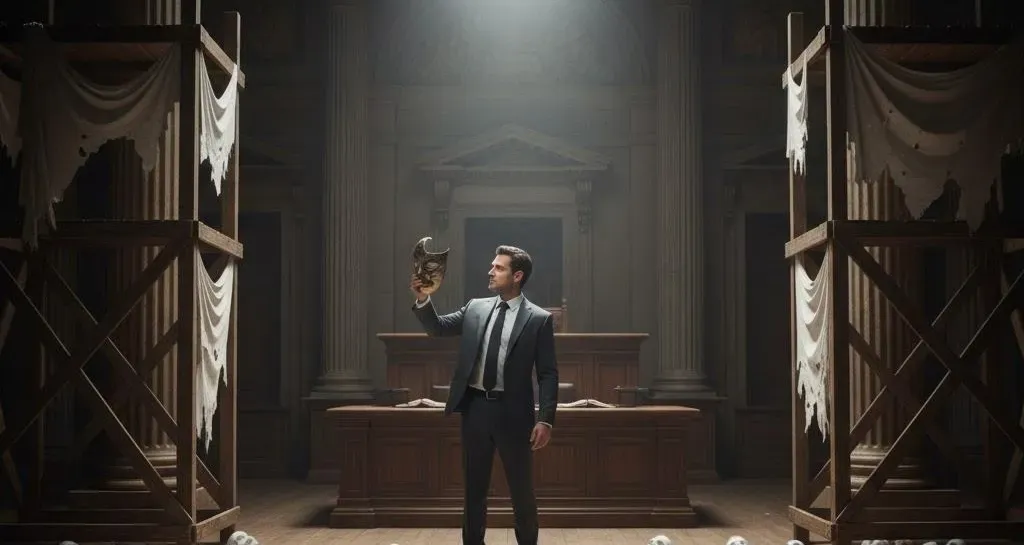
Legal didn’t lose its moat because of AI. It lost when lawyers mistook mastery of text with control of outcomes. We built ivory towers of procedure and precedent while the real decisions were being deployed elsewhere. Now that infrastructure exists without us, and we’re shocked to discover we were never as essential as we believed.
When performance becomes essence, AI doesn’t take the work, it removed the excuse.
MOVEMENT 1: The Alibi
Lawyers think the problem is that they’re too busy.
It isn’t.
Busyness is the alibi that prevents diagnosis.
Somewhere between the templates, the memos, the rituals, and the churn, the profession forgot how to tell judgment from its performance. When you can’t distinguish work that requires you from work that merely looks like it does, everything feels essential. Everything must be done by you. Everything becomes proof you matter.
Busyness is not a time management problem. It is identity collapse.
Article 11 argued judgment is what remains when the noise is stripped away. This is what happens when you’ve spent thirty years pouring concrete over that twenty percent to build a stage.
MOVEMENT 2: The Default Mode
I see it every Monday morning in our business development standup.
A simple huddle. We review last week’s accomplishments. We set this week’s targets. We identify blockers.
The blockers are always the same. Last Monday it was case prep. The Monday before, client calls. This Monday, short week. “Too busy” is the refrain.
The phrase became so empty and repetitive that I banned the phrase in stand-ups. People still mouth it like a prayer.
I banned it not because the work wasn’t real.
Because the alibi was.
“Too busy” means:
I can’t examine what work matters. I can’t evaluate what actually requires me. I can’t look closely because I’m hiding inside my work
Busyness is the shield that prevents lawyers from asking the question they fear most:
What part of this actually requires my judgment?
Most either don’t know, or don’t want to know.
Because the profession trained them to confuse movement with meaning.
MOVEMENT 3: Audience Participation Required
The dirty secret of traditional law isn’t that clients don’t understand what they’re paying for.
It’s that they understand perfectly.
They’re buying something other than legal expertise.
Most legal engagements produce two deliverables: the ostensible work product and the defensibility infrastructure that obscures how simple the judgment could have been.
Clients pay for the second deliverable. The client isn’t ignorant. They’re invested.
The 40-hour document review doesn’t find more issues than the 4-hour review. It creates a paper trail proving ‘we were thorough.
The 200-page diligence memo isn’t more useful than 20 pages. It’s simply more defensible.
This is the theater.
And theater requires audience participation.
The client who says “I need you to look at this” is often saying “I need you to make this look complex enough that I’m covered.”
When they hire outside counsel, they’re not just accessing expertise. They’re externalizing judgment so internal stakeholders can avoid ownership.
When the acquisition fails, nobody internally made the decision. The lawyers “advised” it.
When the regulatory strategy backfires, compliance “relied on counsel.”
The lawyer who generates 200 pages instead of 20 isn’t confused.
They’re giving the client what they’re actually paying for.
Not clarity. Not efficiency.
Distributed accountability.
The work stays opaque because legibility would destroy the alibi. Once 80% of the diligence checklist reads as rote pattern-matching, the performance ends.
Both parties understand the game.
Neither acknowledges it.
The client maintains plausible deniability. The lawyer maintains professional mystique. Everyone exits with their alibi intact.
Law-as-Infrastructure threatens this entire economy. Not because it’s cheaper or faster, but because it makes legal work legible, keeps judgment internal, and eliminates the distributed accountability escape hatch.
It forces clients to own their decisions.
It strips away the theatrical complexity that both parties have been using to avoid responsibility.
The question isn’t whether lawyers have lost the ability to distinguish high-judgment work from systematized processes.
It’s whether both lawyers and clients have a shared interest in maintaining that confusion.
MOVEMENT 4: The Charming Man
There’s a Smiths lyric that captures this perfectly:
Why pamper life’s complexity when the leather runs smooth on the passenger seat?
Why confront whether your work matters, who it hurts, what it changes, or whether you belong in the middle of it… when the performance pays so well?
The prestige car.
The Amex Black.
The smooth perks of the role.
You don’t have to ask whether the work needed you.
You don’t have to examine consequence.
You don’t have to choose.
You just have to perform the part.
The smooth leather is the reward for not asking who you are.
It’s the bargain: perform the role, receive the trappings, never look directly at whether the role required you at all. The job answers “what do you do?” so you never have to answer “who are you?”
And if you never ask that question, you never have to face what might happen if the answer was “nothing.”
MOVEMENT 5: The Collapse
AI is not exposing a skills gap. It is exposing an intention gap.
The profession spent decades building rituals that looked like work. Researching cases everyone already knows. Documenting for thoroughness instead of clarity. Billing for motion instead of outcome.
The lawyers knew. They’ve always known.
They chose volume because volume created space to hide. They chose complexity because complexity justified their presence. They chose the performance because the performance paid.
AI didn’t arrive to take the work. It arrived to ask the question lawyers have avoided for decades:
If the ritual disappears and nothing breaks, was it ever necessary?
This is the real disruption. Not the automation of tasks. The sudden, blinding silence where the performance used to be.
MOVEMENT 6: The Reckoning
The performance is ending.
When it does, you confront what the profession has avoided: what you are without the ritual. If your value came from volume, what happens when volume goes to zero? If your identity was the role, what remains when the role dissolves?
When the performance ends, only judgment remains. For some, that will be enough. For others, it will expose the void they’ve been avoiding.
AI didn’t come to replace lawyers. It came to remove the stage. If you can stand there—without noise, without ritual, without the alibi—this era is an opening.
And when the last ritual is automated and the leather seat is empty, tell me honestly: Was there ever anyone driving at all?