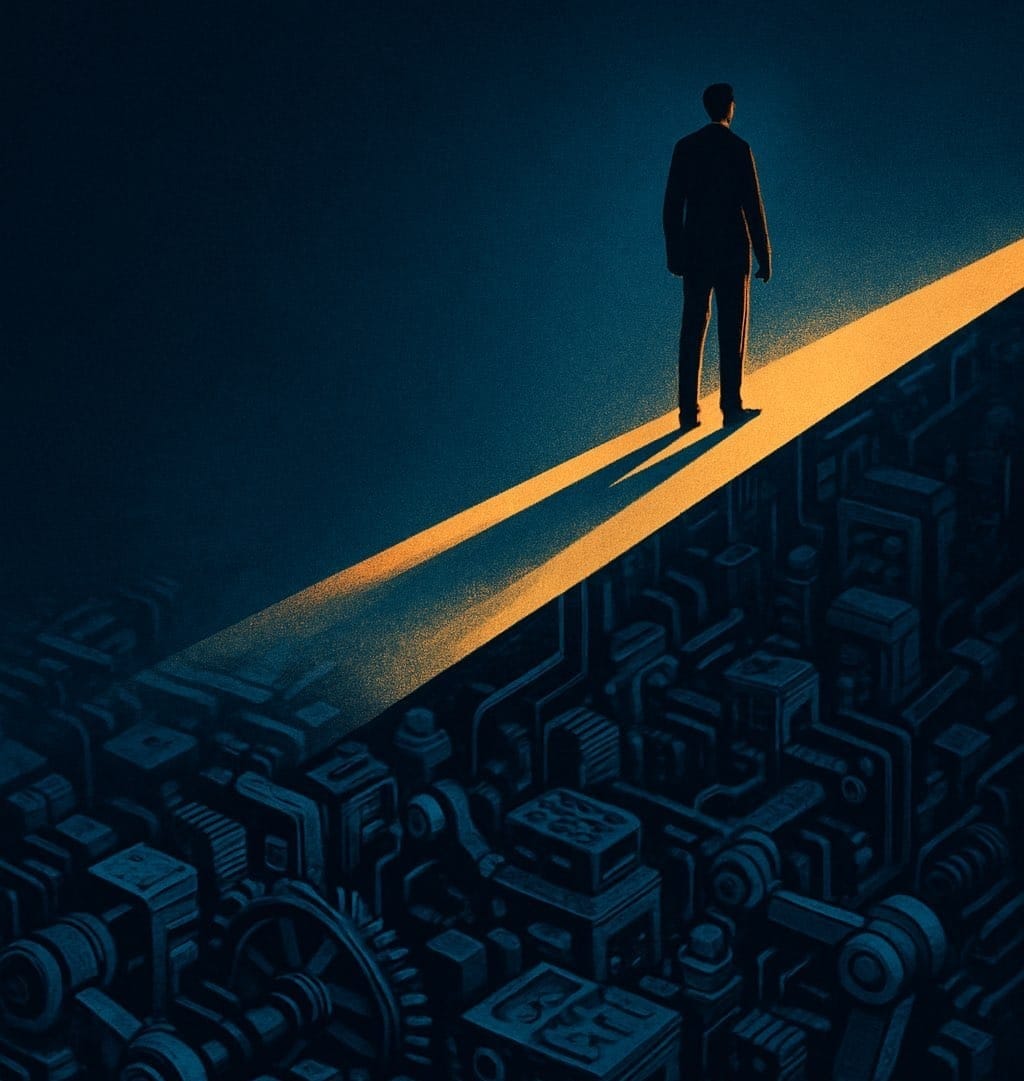
AI did not disrupt legal work. It revealed it. The profession built its identity on tasks that looked like expertise but required almost none of it. Research performed as ritual. Drafting performed as performance. Risk memos written to signal seriousness rather than shape reality. A century of lawyers congratulating one another for manipulating symbols while confusing that manipulation for judgment.
Now the machines do the symbol work faster, cleaner and without the insecurity theater. And instead of confronting the truth, the profession clings to the fantasy that humans possess some mystical reasoning engine unavailable to machines. This is self-flattery dressed up as philosophy. Most legal training and most incentive systems do not reward reasoning. They reward repetition, repackaging, recitation, and hiding behind volume when a real decision carries consequence.
AI stripped away the illusion that the work required us.
What Remains: The Twenty Percent
If eighty percent of legal work is automatable or commodifiable, what remains is the twenty percent. The part of the profession that was always small because it demanded something lawyers have spent generations avoiding. Exposure. Not explanation. Exposure. The willingness to make a decision that carries cost. The willingness to stand in ambiguity without retreating into memos or committees. The willingness to own the moment rather than document it.
This is the territory the machines cannot sterilize. Not because humans are superior, after all, humans are bounded pattern engines running on fragile memory and biased priors. But there is one thing the machine still lacks. It cannot feel consequence. It cannot feel responsibility. It cannot feel the weight that shapes judgment, the gravity that forces the mind to see clearly because the cost of being wrong is personal and real. Until the machine has something to lose, this part of the world remains human.
Today’s lawyers talk about the twenty percent as if it appears only now that AI has consumed the routine work. The profession began here. Judgment was the craft, not a seniority perk. We turned it into the rare exception and called that progress.
Why Legal Technology Preserves the Theater
Watch how legal technology markets itself. “AI-powered contract review.” “Intelligent document automation.” “Enhanced legal research.” These are preservation moves. They’re optimizing the theater rather than closing it down.
The vendors promise to make lawyers faster at ceremonial work. Better at producing the dense memos. More efficient at the ritual. But efficiency at ceremony is still ceremony and faster ritual is still ritual. It is still lawyers billing hours for pattern recognition the machine performs by default. Complexity theater dressed in new technology.
True legal infrastructure doesn’t make lawyers faster at routine work. It eliminates the routine work entirely. It automates the eighty percent so ruthlessly that only the twenty percent remains visible. The part that actually requires human judgment. The part that creates consequence.
But legal technology vendors can’t sell that truth. Because their customers, traditional law firms, need to preserve the ceremony. They need to keep billing for the eighty percent. So the technology becomes another layer of performance. Another way to justify the hours. Another mechanism to avoid the exposure that real judgment demands.
Velocity vs. Correctness: The Moment the Illusion Broke
Years ago I realized how far we had drifted. A founder placed a contract on my desk. It needed work. I did everything a well-trained lawyer does. I tore the document apart. I spotted every exposure. I rewrote every weak clause. I constructed a flawless legal artifact.
He listened, then dismissed it with a wave and told me his philosophy. A breach of contract is only a point on a negotiation curve. A lawsuit is another. Even an adverse judgment can be negotiated into something useful. He wanted velocity and accepted risk. I wanted correctness and insulation. He was operating in the real world. I was performing inside the paper one.
In that moment I saw the truth. Most of our training is ceremony crafted to signal competence rather than create impact. Safety masquerading as diligence. Fear masquerading as rigor. The profession rewards those who avoid personal exposure by generating volume, not clarity. It calls this caution. In reality, it is self-protection dressed as professionalism.
The Guild that Replaced Judgment
This drift did not happen by accident. The modern profession evolved into a closed guild, a medieval holdover masquerading as a meritocracy. Partners as gatekeepers deciding who eats. Associates as supplicants proving loyalty through toil. Precedent as guild secrets hoarded, not shared. Dense memos as dues paid in blood and weekends.
Inside this guild, judgment was never rewarded. Judgment is dangerous. Judgment creates accountability. Judgment forces the lawyer to stand alone and confront the poverty of his own mind.
So the guild did what every closed order has always done: it smothered the threat. Committees. Task forces. Drafts upon drafts. Redlines upon redlines. Research piled on research. Hours and hours spent pretending perfect process and enough paper in the file could abolish risk.
This was never wisdom. This was institutionalized cowardice.
Decoding What Came Before
Everything in the earlier articles in this series led here. Legal infrastructure was never about efficiency. It was erasure: ruthlessly deleting the eighty percent that never required judgment and dragging the profession back to the tiny patch of ground where consequence actually lives.
That ground is the part the profession spent a century fleeing. Judgment is not intelligence. It is temperament. The willingness to see reality without flinching. To decide without hiding behind memos, committees, or review cycles. Judgment is raw exposure. Most lawyers built entire careers learning how never to be exposed.
So the system made exposure unnecessary. Partner sign-offs. Task forces. Endless process. Anything to ensure no one ever stood alone and answerable.
True judgment cannot be audited, standardized, or billed by the hour. It is personal, and therefore fatal to an institution that survives by diffusing responsibility until it disappears.
That is why the territory requiring judgment shrank to almost nothing. The profession rewarded avoidance. When AI arrived, it did not kill our expertise. It revealed how little of it was commonly exercised.
The traditional firm didn’t sell judgment. It sold friction, delay, and complexity theater dressed as rigor. AI erased the friction. The lights came on. The theater went dark.
The eighty percent was never ours. It belonged to pattern and repetition. The machines simply reclaimed it.
What remains is judgment. The undelegatable, uncomfortable kind that carries real cost. The kind the machine will not reach until it can feel the cost of being wrong.
Most lawyers were never asked to live here. The system punished the ones who tried.
AI did not take the work.
It revealed the workers.