“What’s legal going to cost us next quarter?”
Every CFO asks this question. And every general counsel gives the same answer: “It depends.”
Meanwhile, the CFO knows exactly what AWS will cost. Exactly what Salesforce will cost. Exactly what the entire technology stack will cost, because infrastructure is predictable.
Legal services aren’t predictable. And that unpredictability isn’t an artifact of legal complexity or unknown variables. It’s a feature of buying services instead of building infrastructure.
What This Looks Like in Practice
It’s 7:15 AM on Tuesday. Your product launches Friday. Marketing has been pushing the date for six weeks. Customers are expecting it. Your biggest competitor just delayed their competing feature to Q2, which doesn’t mean you have extra time, on the contrary, it means you have a three-month window to own the market. If you can ship.
Your phone buzzes. It’s your head of product. “We need to talk. Legal stuff.”
By 7:45 AM, you’re staring at a whiteboard covered in red marker. The contractor who built your core algorithm didn’t sign an IP assignment. Your privacy policy doesn’t cover the new data collection features. The terms of service template is from 2019 and missing key liability protections. Your payment processor needs updated vendor agreements. Your content moderation policy doesn’t exist. Your international compliance checklist has seventeen open items across five jurisdictions.
In the traditional model, this is where you call an emergency meeting with outside counsel, explain the situation to lawyers who don’t understand your product, and watch them methodically work through issues while your launch window closes and your competitive advantage evaporates.
By 10:00 AM, 46 urgent emails flood your inbox, Slack threads explode, and the HR director barges in with a ‘really urgent’ sexual harassment complaint.
With embedded legal infrastructure, it’s different: The harassment complaint routes to pre-built investigation protocols. The contract questions in Slack get answered by AI agents trained on your company’s standard positions. The urgent emails filter through automated triage that separates actual emergencies from routine anxiety.
This is what legal infrastructure actually looks like.
You Know This Story
You know this story because you’ve lived it. Maybe not this exact Tuesday, but your version of it. The difference between companies that survive it and companies that don’t comes down to one distinction: Legal services means you call someone when there’s a problem. Legal infrastructure means the problem doesn’t happen in the first place.
This isn’t semantic wordplay: Infrastructure doesn’t eliminate every issue, but it handles routine ones, routing complex matters to specialists instead of drowning them in basics.
Most commentary around AI and legal transformation centers on tools that make lawyers faster or more efficient when they should be questioning from first principles whether a lawyer is needed at all.
This isn’t about replacing lawyers with robots. It’s about a legal intelligence layer that replaces lawyer dependency with business enablement. The best general counsel aren’t trying to handle every legal question that arises. They’re building systems so most legal questions never need to be asked.
What Legal Systems Actually Look Like
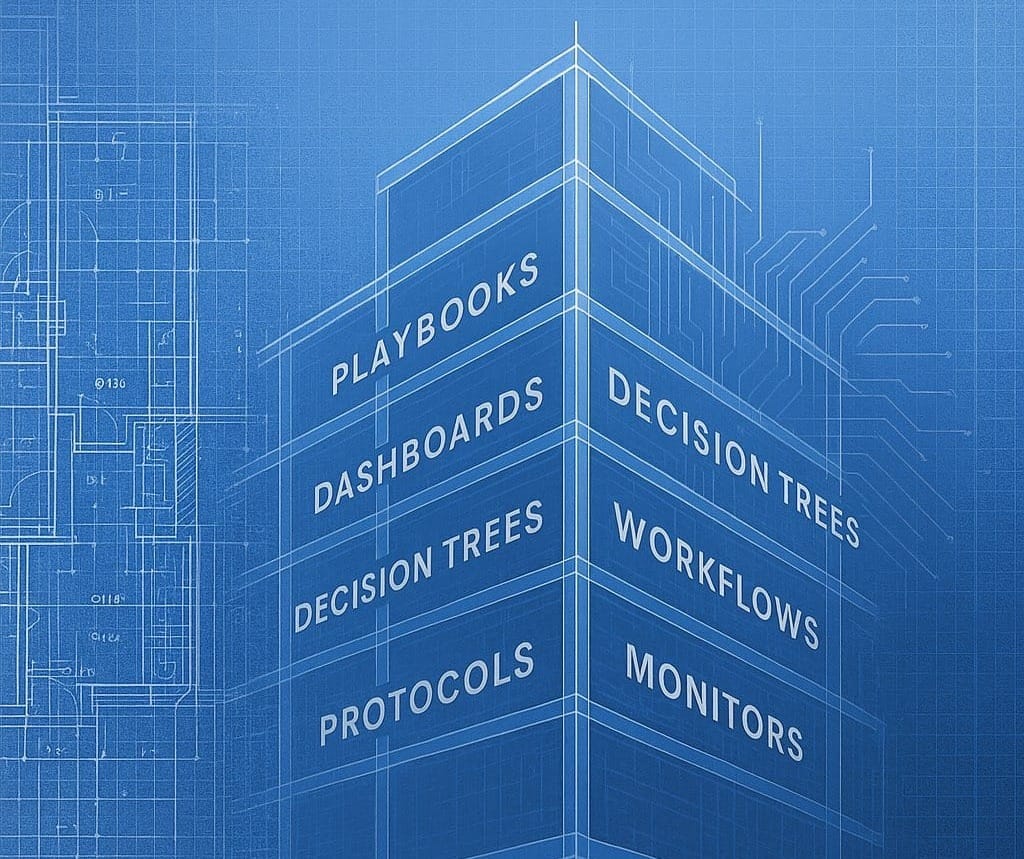
Legal infrastructure is integrated systems applying legal intelligence across your business operations. None of this is particularly exotic or futuristic because these are the same kinds of operational systems that finance, HR, and sales have been using for years. Legal just happens to be the last function that still operates without them. Here are six:
- Beyond the PlaybookNot static document folders, but dynamic, adaptive smart template systems that generate and review contracts based on your specific business patterns and rules. When your product team needs vendor agreements, the system knows your standard payment terms, liability caps, IP protection requirements, projected margins, and how fast you need it done. It routes automatically to the correct approval party producing first drafts that reflect your company’s risk tolerance and negotiation positions, not generic “industry standard” legal language that still needs redlining.
- Compliance Dashboards That Prevent ProblemsBefore embedded legal infrastructure, compliance was reactive, issues surfaced only after audits, complaints, or crises. Each department tracked its own risks, and policy updates lagged behind shifting regulations. Now, compliance dashboards make it proactive. Real-time monitoring maps legal requirements across operations, flags affected products when laws change, and delivers instant guidance for updates. Instead of discovering problems under pressure, you see them forming and resolve them early. Legal moves from firefighting to forward control.
- Decision Trees That Scale JudgmentWhen judgment doesn’t scale, every routine decision drags legal into the loop, contracts stall, terminations wait for review, and simple IP questions consume hours. Errors creep in when overworked teams improvise. Decision Trees fix that. Documented frameworks encode your legal judgment into repeatable processes: contract thresholds, termination checklists, IP protocols. Instead of reinventing answers, teams follow smart pathways that mirror your standards. Core decisions stay consistent and defensible, even when legal capacity is stretched.
- Communication Workflows That Route IssuesHow do you keep legal questions from piling up in the wrong inbox? Communication Workflows automatically route issues to the right place, routine contract questions trigger templates and approvals, while complex matters escalate to specialists. Always-on agents monitor incoming requests, triage in real time, and follow approved escalation paths. Instead of bottlenecks and guesswork, every issue lands with the right expert at the right moment.
- Crisis Protocols That Defuse PanicWithout defined crisis protocols, every emergency becomes chaos, leaders panic, communication breaks down, and legal scrambles to invent a response in real time. Crisis Protocols stop that spiral. They activate structured workflows for harassment claims, security breaches, or volatile terminations, complete with timelines, documentation steps, and communication scripts. No improvising under pressure, no reinventing the wheel. Each high-risk event follows a tested playbook that contains risk, protects the company, and keeps operations steady.
- Governance Watchdogs That Spot Trouble EarlyGovernance Watchdogs keep your business clean before problems exist. Automated monitors scan operations for gaps, flagging missing approvals, lapsed authorizations, and approaching regulatory deadlines. Contract obligations, board actions, and equity plans stay under continuous watch, renewals, milestones, and vesting schedules surface before they slip. Instead of reacting to violations, you catch them in motion. Governance becomes predictive, not corrective.
How These Systems Actually Work Together
The power emerges when these systems work together to create legal infrastructure that operates at business speed.
As in Tuesday’s vendor agreement crisis, the template system generates the first draft, the decision tree determines approval requirements, the communication workflow routes it to the right stakeholders, and the compliance dashboard confirms it meets current regulatory standards. No meetings required. No research delays. No lawyer bottlenecks.
This is legal infrastructure: interconnected systems that enable business velocity instead of constraining it. Legal judgment embedded in business operations instead of bottlenecked through individual lawyers. Prevention built into daily operations instead of crisis response after problems surface.
Your Tuesday morning becomes manageable not because you work harder, but because your legal function works smarter.
When It Just Works
When this infrastructure is working, really working, your Tuesday transforms completely.
At 7:15 AM, your product head calls there is no panic. The dashboard shows green lights; IP issues resolve via automation in minutes, not meetings. Terms of service generate automatically from templates that already reflect your data collection patterns.
The 46 urgent emails get triaged instantly: routine questions answered by decision trees, actual emergencies escalated appropriately, everything else queued for batch processing. The Slack notifications stay manageable because your team has self-service tools for common legal questions.
When the HR director needs “just a minute,” the harassment complaint protocol activates immediately with investigation timelines, documentation requirements, and communication scripts already prepared. No scrambling. No reinventing procedures. No legal research while someone’s career hangs in the balance.
By 10:00 AM, you realize something strange: you’re calm. Not because nothing’s happening, but because your legal function is handling everything that would normally have your entire day on fire.
By noon, you’re thinking strategically about market positioning and competitive advantage (the work you were hired to do) instead of managing legal process problems that systems should handle.
By 2 PM, you have something that used to be impossible: a free afternoon. Not free because nothing’s happening, but free because your legal infrastructure is handling the routine emergencies that would normally consume your day. Free to join the C-suite strategy session about market expansion. Free to think through the competitive implications of Friday’s launch. Free to plan the roadmap for Q2 while staying on the pulse of what’s actually happening in your business.
Your legal function becomes what it was always supposed to be: an engine for business acceleration, not a brake on company velocity. You become what you were hired to be: a strategic partner who can think beyond today’s crisis because today’s crises are managed systematically.
This is what business velocity with legal protection actually looks like.
And this is just Tuesday.
Implementation Reality
But let’s be clear: this infrastructure doesn’t happen overnight, and it’s not available as a single off-the-shelf product.
Building legal systems that operate at business velocity requires three components working together: programmatic solutions that automate routine decisions, right-minded in-house resources who understand both law and operations, and outside counsel partners who are aligned with infrastructure thinking rather than billable hour maximization.
The template libraries need to be built from your actual business patterns, not “industry standards” or generic legal forms. The compliance dashboards require integration with your specific regulatory environment and business systems. The decision trees must reflect your company’s risk tolerance and operational realities. The crisis protocols need to account for your industry, team structure, and communication preferences.
This means investment: time to build the systems, resources to maintain them, and partnership with legal providers who understand that their success depends on your business velocity, not their utilization rates.
Most companies have pieces of this infrastructure already. Some have contract templates in shared drives, compliance spreadsheets, employment policies, and other piecemeal legal judgment separated from the decision-making framework. The transformation happens when these pieces become integrated systems designed for decision speed rather than scattered tools optimized for lawyer convenience.
The work is worth it because the alternative, traditional legal services, simply cannot match the velocity that businesses need.
The Only Question Remaining
The question isn’t whether legal becomes infrastructure. Every other business function already made this transition.
Finance went from accountants to QuickBooks to NetSuite. HR went from filing cabinets to ADP to Workday. Sales went from Rolodexes to Hubspot to Salesforce.
Legal is following the same path. And the transition is accelerating because the infrastructure template is proven, the technology maturity is higher, and the client demand is stronger than in previous professional services transformations.
The question is whether you build it, buy it, or watch your competitors use it against you.
Because the next time legal issues emerge three days before your product launch, you’ll either have infrastructure that handles it systematically, or you’ll be scheduling calls for next week while your competitor ships to your customers.
The market doesn’t wait for perfect legal analysis anymore. It rewards companies that can make legally-protected decisions at business velocity.
This transformation is already happening. The only question is whether you’re building it now, or explaining next quarter why you didn’t.